Canada's new drone rules, explained
 By Wayne Bryant, 12,000-hour captain and TC Advanced RPAS pilot · Updated October 2026
The five biggest changes
- Medium drones are now covered. Part IX used to stop at 25 kg. Drones over 25 kg and up to 150 kg can now be flown under Advanced or Level 1 Complex rules when the safety assurance and operating requirements are met.
- Advanced privileges expanded. Advanced pilots can now conduct sheltered operations close to buildings and structures, extended visual line of sight (EVLOS) operations with a trained visual observer, and medium-drone flights within visual line of sight.
- Lower-risk BVLOS without an SFOC. The new Pilot Certificate – Level 1 Complex Operations allows qualifying lower-risk BVLOS flights, conducted under an RPAS Operator Certificate (RPOC). The old shortcut "BVLOS always needs an SFOC" is no longer true.
- Standard 922 safety assurance matters more. Many Advanced and Complex privileges depend on the drone having the right manufacturer declaration for that exact operation. Holding an Advanced certificate isn't enough on its own.
- Recency is about training, not flying. Your certificate doesn't expire, but you need an accepted recurrent training activity within the previous 24 months, with proof. Simply having flown recently doesn't count.
Weight categories at a glance
| Operating weight | Category | What it means |
|---|---|---|
| Under 250 g | Micro | No registration or pilot certificate normally required, but you must still fly safely. |
| 250 g – 25 kg | Small | Basic, Advanced, Level 1 Complex or Special, depending on the operation. |
| Over 25 kg – 150 kg | Medium | Advanced or Level 1 Complex when the safety assurance and operating requirements are met. |
| Over 150 kg | Large | Special operation; SFOC required. |
Basic, Advanced and Level 1 Complex compared
| Privilege | Basic | Advanced | Level 1 Complex |
|---|---|---|---|
| Small drone within VLOS | Yes | Yes | Yes |
| Controlled airspace | No | Yes* | Yes* |
| Near or over people | No | Yes* | Yes* |
| Sheltered operations | No | Yes | Yes |
| EVLOS | No | Yes | Yes |
| Medium drones | No | Yes* | Yes* |
| Lower-risk BVLOS | No | No | Yes* |
* Requires the applicable operating conditions, permissions and safety-assurance declaration. Level 1 Complex operations must be conducted under an RPOC.
The numbers that still matter
- Altitude: 122 m (400 ft) above ground level, unless another authority or condition applies.
- Basic operations: more than 30 m horizontally from people not involved, more than 5.6 km (3 NM) from the centre of a certified airport, and more than 1.9 km (1 NM) from a heliport.
- Advanced near people: closer than 30 m but at least 5 m, with a 922.05 declaration. Over people (under 5 m) needs a 922.06 declaration.
- Sheltered operations: no more than 30 m above the structure, within 61 m horizontally, and at least 30 m from people not involved.
- EVLOS: uncontrolled airspace, at least 30 m from people not involved, and within 2 NM (3.7 km) of the pilot, control station and visual observer.
When you still need an SFOC
A Special Flight Operations Certificate is still required for operations outside Basic, Advanced and Level 1 Complex authority. That includes advertised events (even with a microdrone), drones over 150 kg, flying above 122 m when not otherwise authorized, more than five drones within VLOS or more than one BVLOS, higher-risk BVLOS, BVLOS in an aerodrome environment, and hazardous payloads.
Check which category your drone and your typical flights fall into, confirm your drone has the safety-assurance declaration your operations need, and make sure your recency is current. Transport Canada's 2025 summary of changes is the official reference.
Keep the new rules in your flight bag
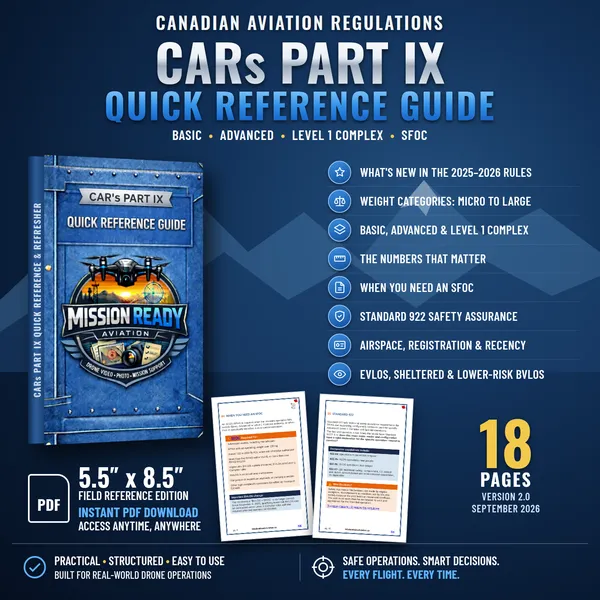 CARs Part IX Quick Reference Guide v2.0Canada’s drone rules on 18 pages, updated for 2025–2026.$24 CAD · Buy now →
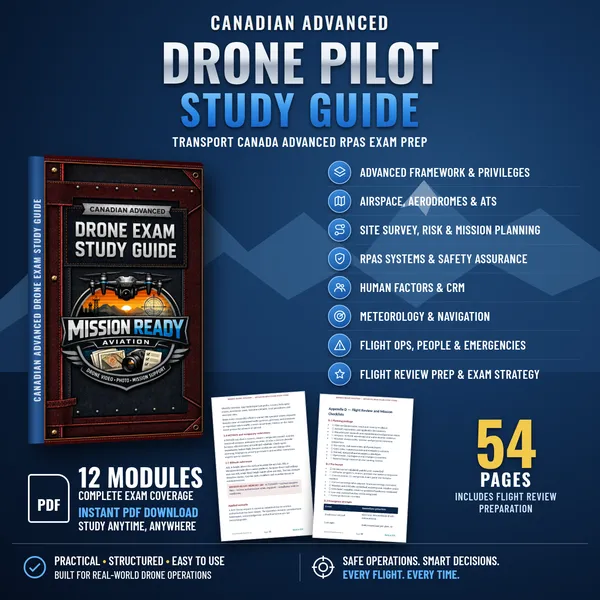 Canadian Advanced Drone Pilot Study GuidePrepare for the Advanced exam and flight review.$49 CAD · Buy now →
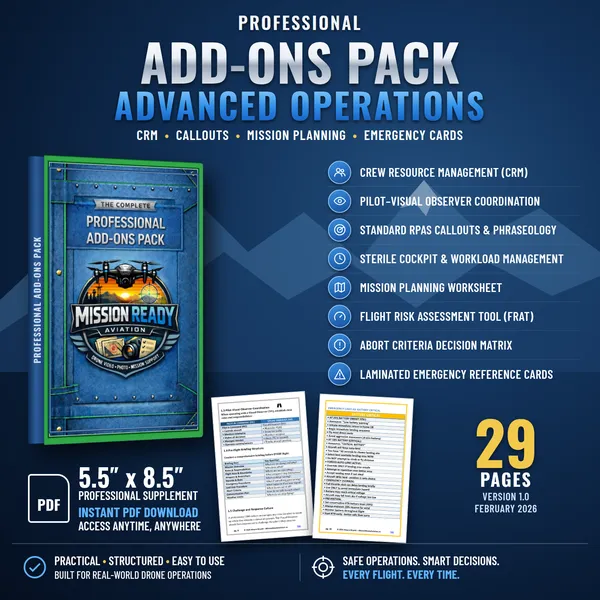 Professional Add-Ons PackCRM, callouts, mission planning and abort criteria.$30 CAD · Buy now →
Frequently asked questions
Current as of October 2026. Independent educational information, not legal advice. Mission Ready Aviation is not affiliated with Transport Canada, the FAA or any drone manufacturer. Always confirm the current rules with the official sources before you fly.