How to get your drone licence in Canada
 By Wayne Bryant, 12,000-hour captain and TC Advanced RPAS pilot · Updated October 2026
Step 1: Decide which certificate you need
The Basic certificate covers flying in uncontrolled airspace, more than 30 m from people who aren't involved, and away from airports and heliports. You need Advanced to fly in controlled airspace, closer than 30 m to people, or to use newer privileges like EVLOS and sheltered operations. Level 1 Complex is for qualifying lower-risk BVLOS operations.
| Basic | Advanced | Level 1 Complex | |
|---|---|---|---|
| Minimum age | 14 | 16 | 18 |
| Online exam | 35 questions, 90 minutes, 65% to pass | 50 questions, 60 minutes, 80% to pass | Advanced exam, plus Level 1 Complex exam |
| Ground school | Recommended | Recommended | At least 20 hours required |
| Flight review | No | Yes, with a flight reviewer | Yes, Level 1 Complex flight review |
Exam details from Transport Canada. Fees apply for exams and certificates; check Transport Canada for current amounts.
Step 2: Study for the exam
Transport Canada strongly recommends training before the exam. The questions come from its published knowledge requirements, which cover air law, airspace, weather, navigation, human factors, flight operations and theory of flight. That document lists the topics but isn't a study guide, so most people use a course or a structured guide.
Step 3: Take the online exam
- Create an account on Transport Canada's Drone Management Portal.
- Pay the exam fee and take the exam online. You get your result as soon as you finish.
- If you don't pass, you must wait 24 hours before trying again.
- For Basic, your certificate is issued once you pass. For Advanced, keep the reference number you're given; you'll need it to book your flight review.
Step 4: Book your flight review (Advanced)
After passing the Advanced exam, book a flight review with a flight reviewer through a drone flight school. You'll demonstrate that you can plan and fly safely, including site survey and emergency handling. Your drone must be registered and marked before the review.
Step 5: Register and mark your drone
Every drone with an operating weight of 250 g or more must be registered through the Drone Management Portal, and the registration number must be clearly marked on the aircraft. Weigh your drone as you fly it, with battery and accessories.
Step 6: Stay current
Your certificate doesn't expire, but you must complete an accepted recurrent training activity within the previous 24 months and keep proof. Options include a Transport Canada-endorsed safety seminar, self-paced study program, recurrent training program, or passing an RPAS pilot exam.
You must be able to show your pilot certificate and registration when operating. Keep digital or paper copies with your gear. Start at Transport Canada's drone safety pages.
Study with a working captain
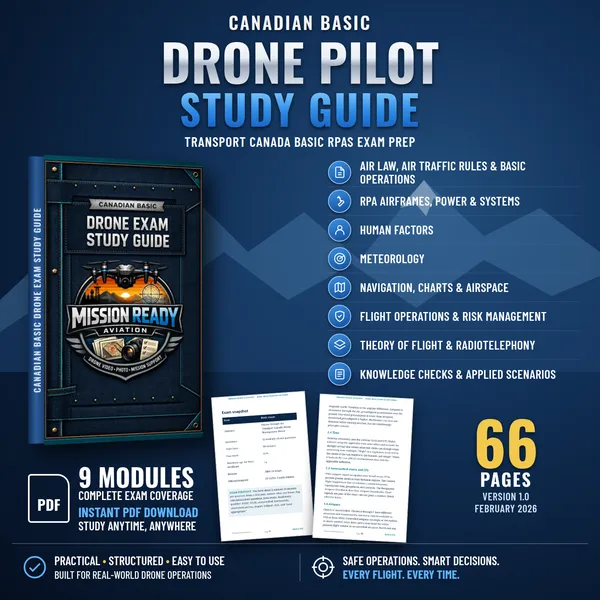 Canadian Basic Drone Pilot Study GuidePass your basic drone licence exam, with nine plain-language study modules.$39 CAD · Buy now →
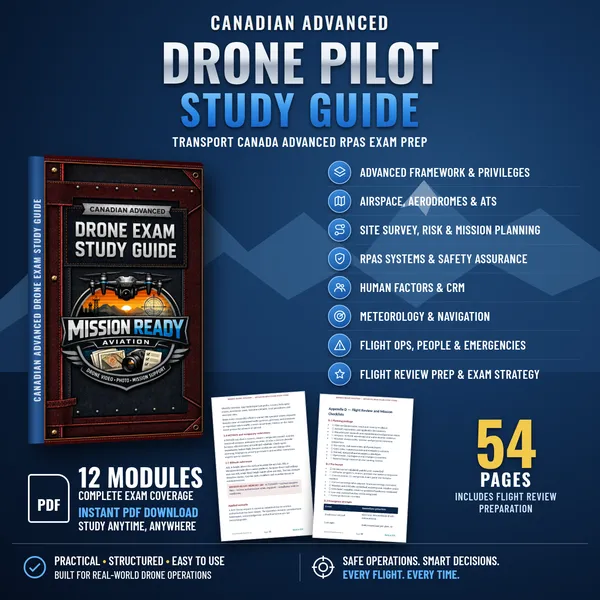 Canadian Advanced Drone Pilot Study GuidePrepare for the Advanced exam and flight review.$49 CAD · Buy now →
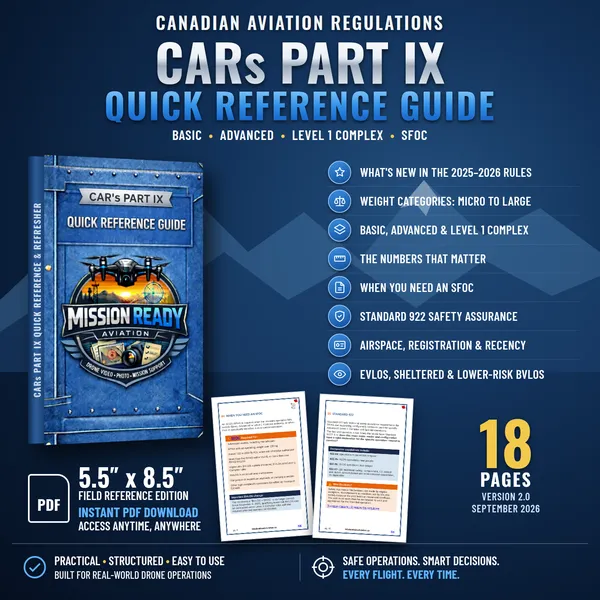 CARs Part IX Quick Reference Guide v2.0Canada’s drone rules on 18 pages, updated for 2025–2026.$24 CAD · Buy now →
Frequently asked questions
Current as of October 2026. Independent educational information, not legal advice. Mission Ready Aviation is not affiliated with Transport Canada, the FAA or any drone manufacturer. Always confirm the current rules with the official sources before you fly.