Can I legally fly my drone here? Canada and U.S. rules
 By Wayne Bryant, 12,000-hour captain and TC Advanced RPAS pilot · Updated October 2026
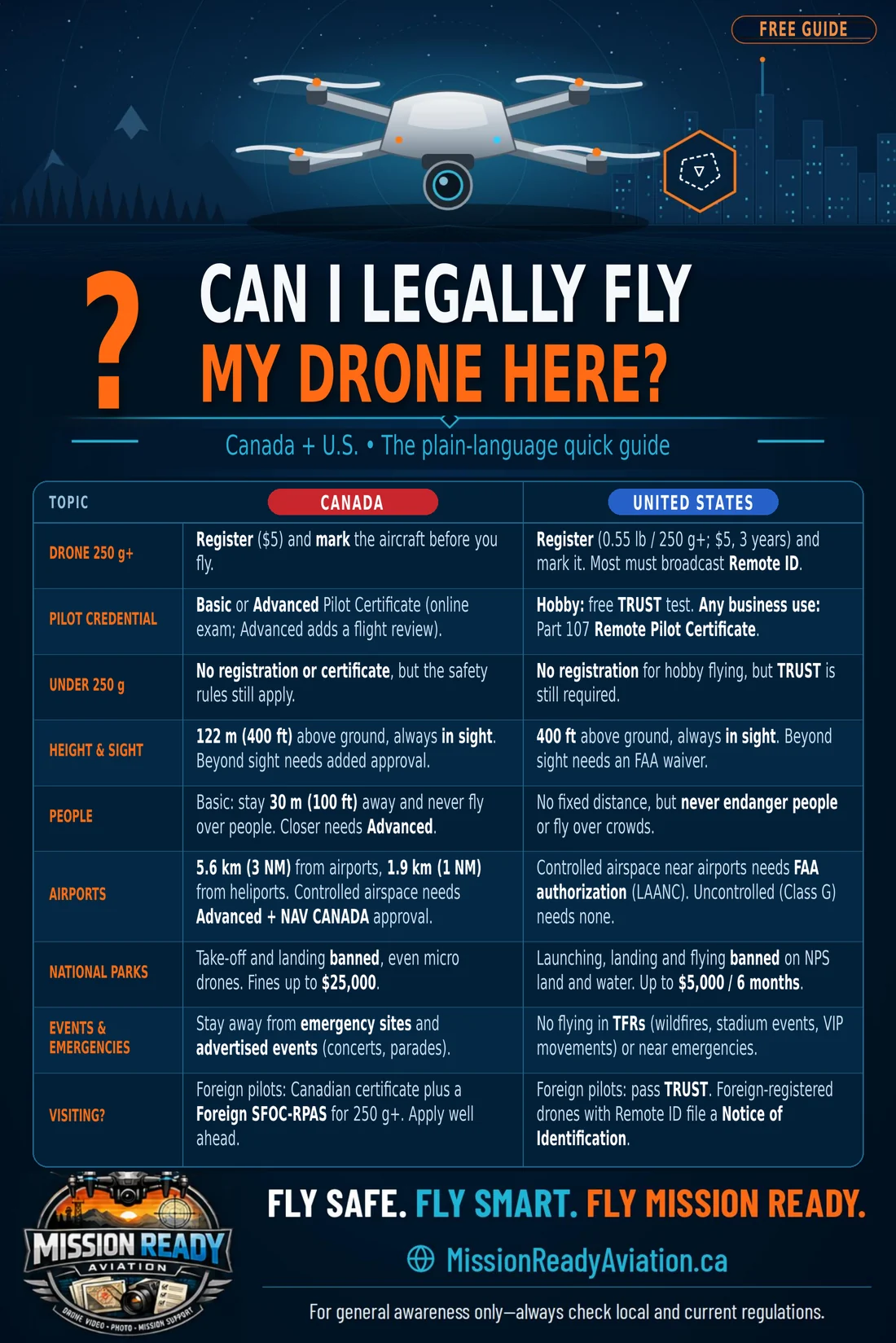
Canada vs. U.S. at a glance
| Canada | United States | |
|---|---|---|
| Drone 250 g+ | Register and mark the aircraft before you fly. | Register (0.55 lb / 250 g+; $5, 3 years) and mark it. Most must broadcast Remote ID. |
| Pilot credential | Basic or Advanced Pilot Certificate (online exam; Advanced adds a flight review). | Hobby: free TRUST test. Any business use: Part 107 Remote Pilot Certificate. |
| Under 250 g | No registration or certificate, but the safety rules still apply. | No registration for hobby flying, but TRUST is still required. |
| Height and sight | 122 m (400 ft) above ground, always in sight. Beyond sight needs added approval. | 400 ft above ground, always in sight. Beyond sight needs an FAA waiver. |
| People | Basic: stay 30 m (100 ft) away and never fly over people. Closer needs Advanced. | No fixed distance, but never endanger people or fly over crowds. |
| Airports | 5.6 km (3 NM) from airports, 1.9 km (1 NM) from heliports. Controlled airspace needs Advanced + NAV CANADA approval. | Controlled airspace near airports needs FAA authorization (LAANC). Uncontrolled (Class G) needs none. |
| National parks | Take-off and landing banned, even micro drones. Fines up to $25,000. | Launching, landing and flying banned on NPS land and water. Up to $5,000 / 6 months. |
| Events and emergencies | Stay away from emergency sites and advertised events (concerts, parades). | No flying in TFRs (wildfires, stadium events, VIP movements) or near emergencies. |
| Visiting? | Foreign pilots: Canadian certificate plus a Foreign SFOC-RPAS for 250 g+. Apply well ahead. | Foreign pilots: pass TRUST. Foreign-registered drones with Remote ID file a Notice of Identification. |
Summary of the main rules. Exceptions and details are explained in the steps below.
Step 1: Start with your drone's weight
The line that matters most is 250 g (0.55 lb). At or above it, you register and mark the drone in both countries. Weigh your drone the way you fly it, with battery and accessories.
- Canada, under 250 g: no registration or pilot certificate, but the safety rules still apply and you can't fly at advertised events without special permission.
- U.S., under 250 g: no registration for hobby flying, but you still need to pass TRUST. Business use is Part 107 whatever the weight.
Step 2: Get the right credential
Canada: a Basic certificate covers uncontrolled airspace and at least 30 m from bystanders. Advanced is for controlled airspace or closer to people, and adds an in-person flight review. The full walk-through is in How to get your drone licence in Canada.
United States: for hobby flying, pass the free TRUST test and carry proof. For any business use, even monetized video, you need a Part 107 Remote Pilot Certificate, with free recurrent training every 24 months.
Step 3: Check the airspace
Canada: Basic flying means uncontrolled airspace, at least 30 m (100 ft) from bystanders, 5.6 km (3 NM) from airports and 1.9 km (1 NM) from heliports. Controlled airspace is Advanced territory and needs NAV CANADA approval. The NRC Drone Site Selection Tool and NAV CANADA's RPAS pages help you find a legal spot.
United States: controlled airspace around airports needs FAA authorization, usually through LAANC. Uncontrolled (Class G) airspace doesn't. Check for TFRs and NOTAMs before every flight, and never fly in a TFR or near emergency operations.
Step 4: Check the land
- National parks, both countries. Parks Canada bans take-off and landing, micro drones included, with fines up to $25,000. The U.S. National Park Service bans launching, landing and flying on its land and water, with penalties up to $5,000 and six months.
- Emergency scenes and wildfire areas. If responders are working, your drone is a hazard to them.
- Events. Advertised events in Canada; TFR zones around stadium events and VIP movements in the U.S.
- Private property and privacy. You need permission to take off from someone's land, and privacy laws apply to what you record.
Step 5: Stay inside the flying limits
In both countries the general limit is 400 ft (122 m) above ground level, and you keep the drone in visual line of sight. Beyond-sight flying is a special case. Canada now has defined pathways for qualified pilots (see Canada's new drone rules, explained), and in the U.S. it still needs an FAA waiver.
The proposed U.S. rule for routine beyond-visual-line-of-sight flying is not final as of October 2026, and nothing in it changes today's hobby rules.
Step 6: Visiting the other country?
U.S. pilots in Canada
- Under 250 g: no registration or SFOC needed (except at advertised events). Follow the safety rules.
- 250 g and up: you need a Canadian drone pilot certificate, even if you're certified at home.
- Foreign pilots can't register drones in Canada, so you apply for a Foreign SFOC-RPAS instead. Apply well before your trip.
Canadian pilots in the U.S.
- Hobby flying: pass TRUST and carry proof.
- A foreign-registered drone with Remote ID needs a Notice of Identification filed with the FAA before you fly. Without Remote ID, fly only in an FAA-Recognized Identification Area.
- Paid work: Part 107 plus DOT economic authority.
Heading south? Flying your drone in the USA as a Canadian has the full walk-through.
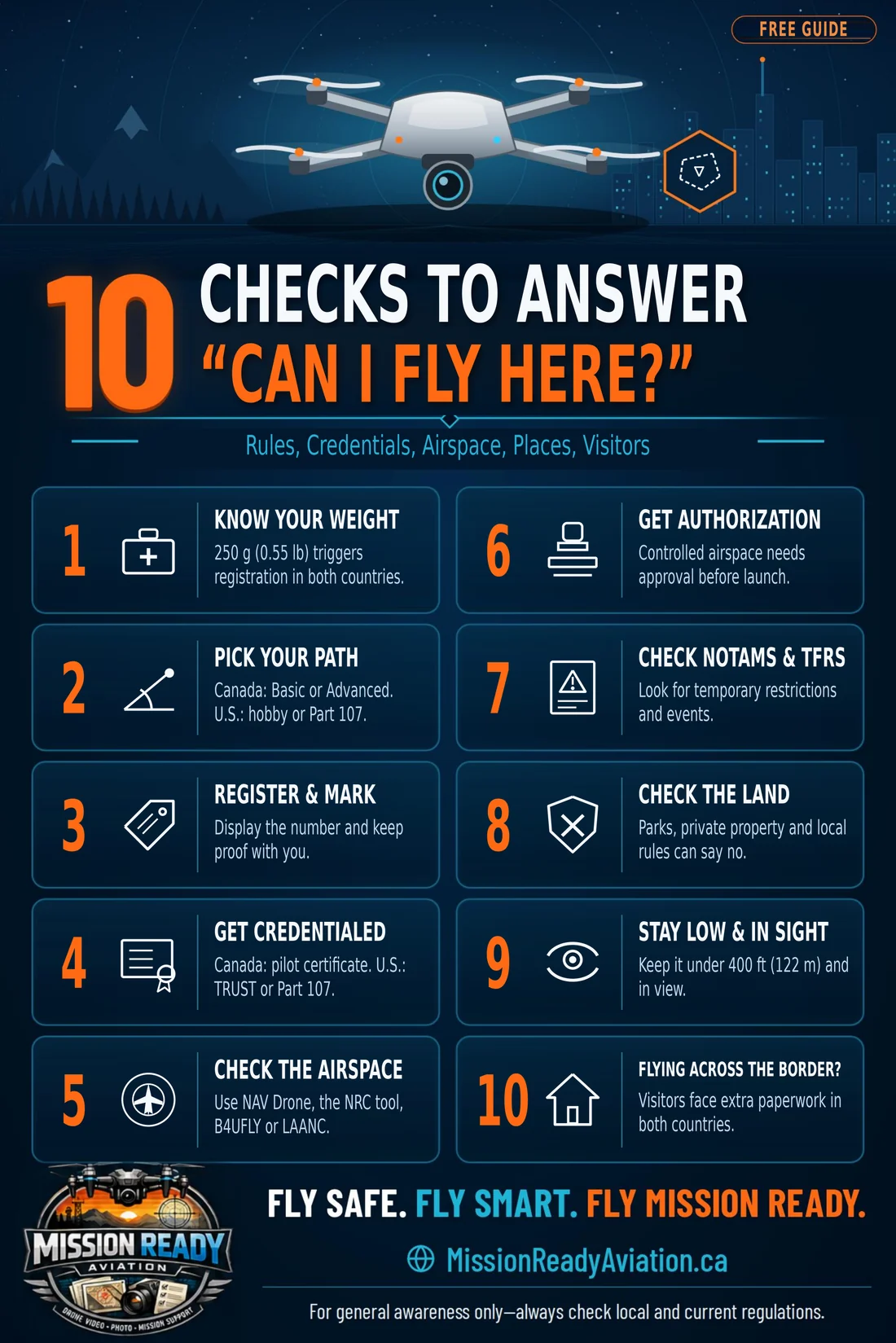
Run the 10 checks before every flight
Transport Canada drone safety · NRC Drone Site Selection Tool · NAV CANADA RPAS · FAA drones · FAA international operators. For parks, check the specific Parks Canada or National Park Service page before you go.
Study with a working captain
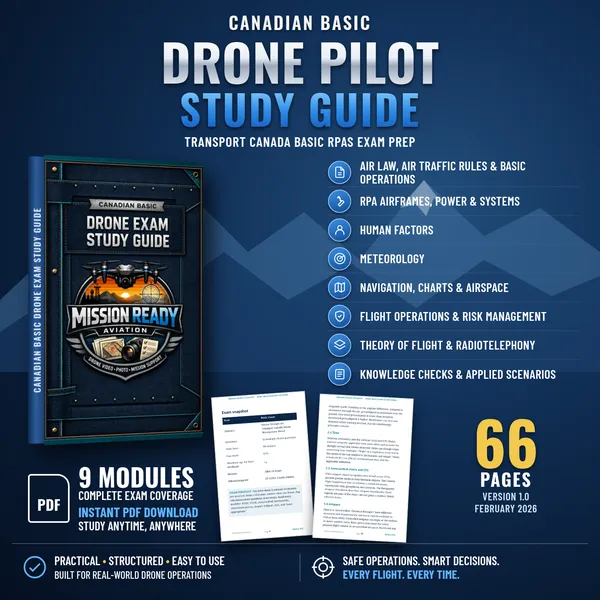 Canadian Basic Drone Pilot Study GuidePass your basic drone licence exam, with nine plain-language study modules.$39 CAD · Buy now →
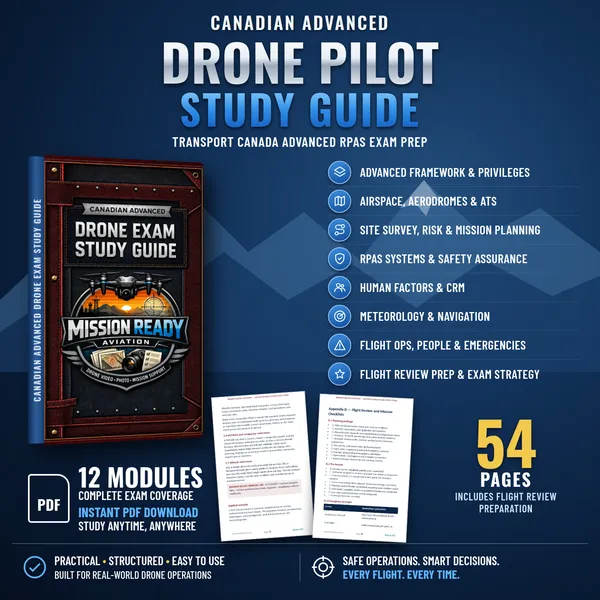 Canadian Advanced Drone Pilot Study GuidePrepare for the Advanced exam and flight review.$49 CAD · Buy now →
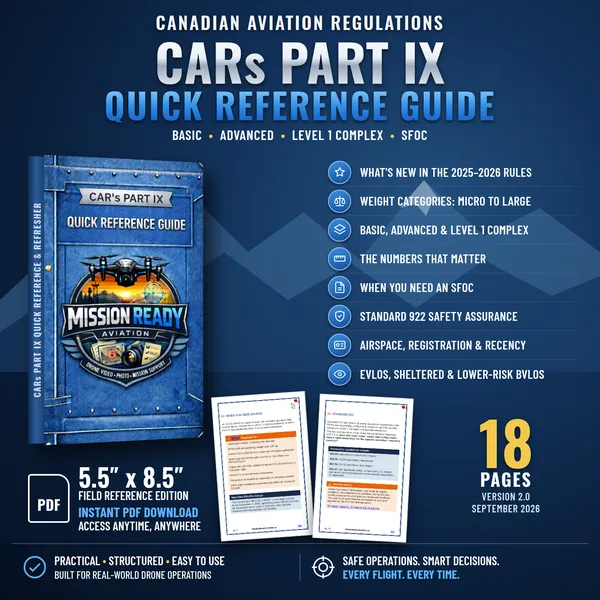 CARs Part IX Quick Reference Guide v2.0Canada’s drone rules on 18 pages, updated for 2025–2026.$24 CAD · Buy now →
Frequently asked questions
More guides
Current as of October 2026. Independent educational information, not legal advice. Mission Ready Aviation is not affiliated with Transport Canada, the FAA or any drone manufacturer. Rules change, and cities, states, provinces and individual parks add their own. Always confirm the current rules with the official sources before you fly.